Drawing in Metal

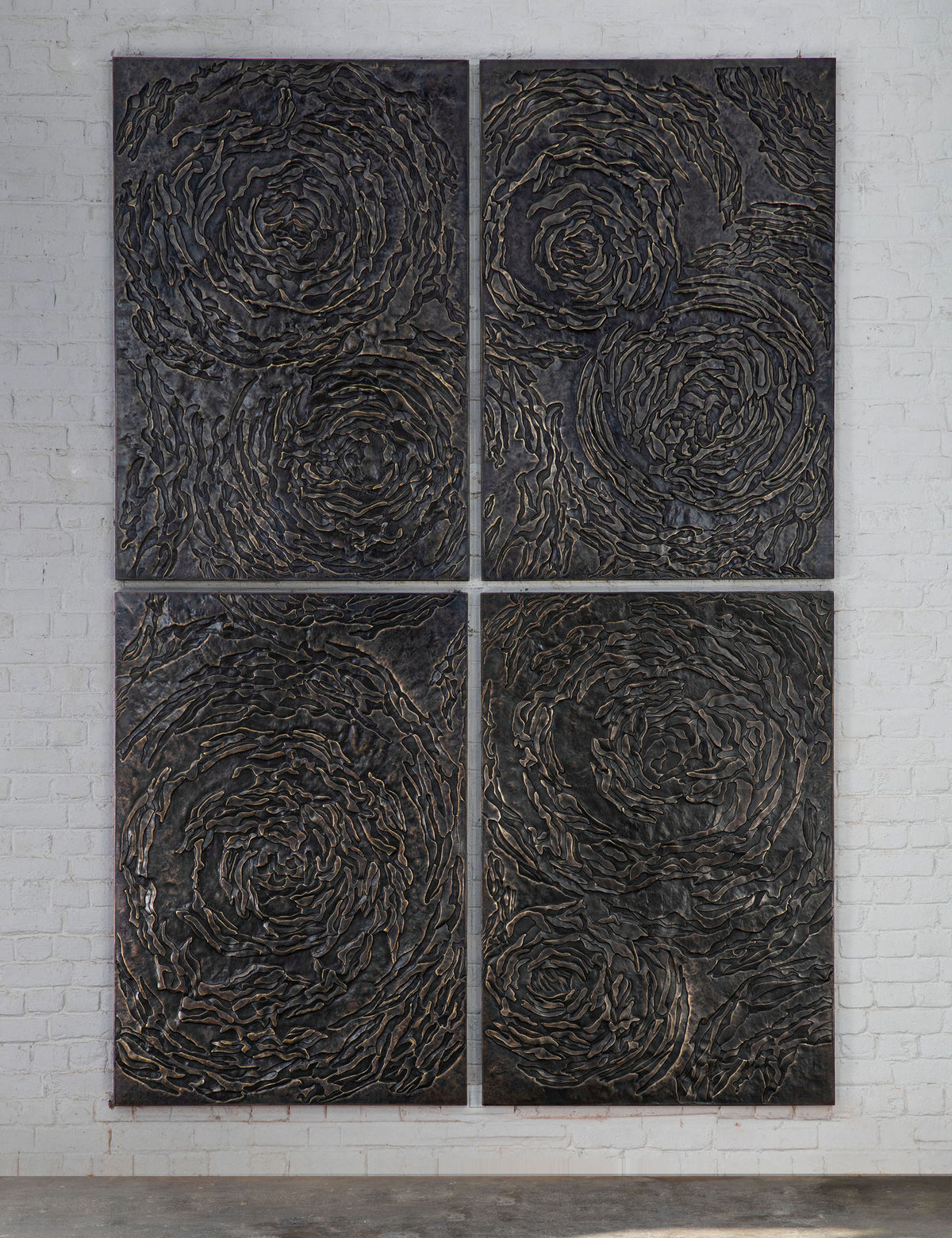
India Art Fair collaborated with designer Vikram Goyal for a special screening of ‘Drawing in Metal’, a short film about the studio’s relationship with the metalworking technique of repoussé. Directed by Aradhana Seth, ‘Drawing In Metal’ is a documentary that focuses on how repoussé comes to life in the artist’s ‘karkhana’, or studio. The intricacy of the technique–the process of hammering metal into relief from the reverse–is looked at closely, with attention to its smallest details.
The film explores the nuances of the process–the beating, hammering, pouring, grinding and chiseling of the metal that leads to its final form. The technique is key to some of the studio’s most elaborate, layered artworks, bringing textured visuals to a metal canvas in a way only this technique allows. “Repoussé for me is very special,” says Vikram Goyal. “There’s a great, dynamic play between how much pressure is applied on one part, because it is at the expense of its neighboring areas. This is where the skill of an artisan comes into play. No piece comes out exactly the way the designer imagined it, because there’s no way the designer can guess how much pressure is going to be applied. Which makes each piece unique and special; and that’s the beauty of repoussé."
Brass is the beating heart of Goyal’s work, in large part for its place in Indian structure and culture. “The material I choose to work with, brass, is an old, traditional material. There is a richness to it.” Art historian and curator Annapurna Garimella adds that it links back to the Indian penchant for gold. “Brass is not a substitute for gold, but it’s part of that spectrum of the gold aesthetic. It’s not a pure metal; and that’s what makes it such an interesting material. Because it is used for moments where more purity is required.”
For Aradhana Seth, telling the story as thoughtfully and sensitively as possible was paramount. The film was shot in three days, with many days prior to it spent on copious research. “We had to be careful about choosing what we wanted to shoot and keeping it tight,” says Seth.
“We would often bring in different kinds of furniture into the form–repoussé and beyond–so you could understand the scope of the workshop subliminally,” says Seth. The visual treatment of the film centers around the richness of the brass as it is worked upon in various forms; from the metal sheet that will be placed upon the wax bed, to being shaped with tools until it tells the story that was imagined on paper by the Vikram Goyal team. “When you make a film, you always start with a blank canvas,” says Seth. “For me, I go in with the knowledge that I have about the subject compartmentalised into one part of my brain. I begin researching, observing and having conversations which helps me visualise the film and take it in the direction I would like to go. From the start of the shoot, I wanted to use the many metal sounds from the workshop as the soundtrack. They are an integral part of the sound design.”
The sound of metal as it bubbles to a boil, or clangs beneath the hammer, immerses the viewer further in the process of the brass being shaped into the story it will tell. “Like all craft, the way to work with the material is completely embodied,” says Garimella. “In drawing, if you exhale or inhale a jagged breath, your line comes out jagged. There is always this question of managing the energy in the craftsman’s body, and breath being that energy as they wield the hammer and the chisel.”
The most important element for Seth was the ‘jugalbandi’. “There were many types of jugalbandi [intertwining's] that I wanted to explore. The first, between the brass and the raal [wax], and how they work together and complement each other. Then, between the design studio and the workshop. And lastly, cinematically; with the metal sounds as the soundtrack of the film. There are multiple jugalbandis.”
LINK TO THE FILM | DRAWING IN METAL